
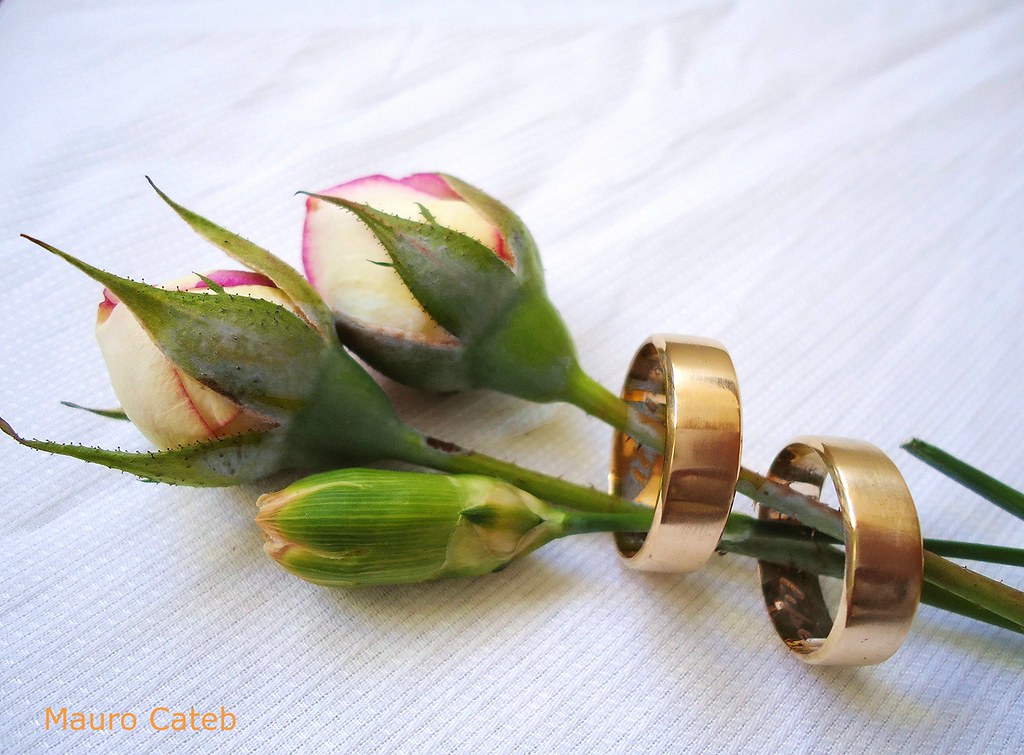
 Photo by Mauro Cateb via Flickr (CC BY 2.0)
Choosing a wedding ring is more than picking out a band. Behind this piece of jewelry lies a thousand-year-old history, a powerful symbolism and a set of traditions that vary from one culture to another. Understanding what the wedding ring represents helps you make a meaningful choice, beyond aesthetic considerations alone.
The ancient origins of the wedding ring
The wedding ring is among the oldest pieces of jewelry in human history. The earliest traces go back to ancient Egypt, where couples exchanged rings braided from reeds or hemp. The circle, with no beginning or end, already embodied the eternity of the bond.
In Rome, the ring took on a legal value. Forged in iron, it sealed a genuine contract between families and committed the given word. Gold gradually replaced iron, a sign of the value placed on the union and of the prosperity wished upon the spouses.
The Romans also popularized the idea of the vena amoris, the vein of love, believed to connect the left ring finger directly to the heart. This anatomical belief, now disproven, still explains the choice of finger on which the ring is slipped across much of the Western world.
The symbolism of the ring and the meaning of the exchange
If the wedding ring has crossed the centuries, it is because its shape carries a universal message. The closed circle evokes continuity, the absence of rupture, a union that knows no end. To offer a ring is to offer a promise made visible.
The exchange of rings during the ceremony marks a precise moment: the one when the commitment becomes public and reciprocal. Each spouse slips the ring onto the other’s finger, a gesture that seals the mutual consent before the witnesses.
The metal itself takes part in the symbol. Gold, unalterable, does not tarnish or rust. This resistance to time echoes the durability sought in marriage. It is also why the wedding ring is often passed down from generation to generation, carrying a family memory.
Which hand and which finger for the wedding ring
The question comes up systematically, because customs differ sharply from one country to another. In France, Italy, the United Kingdom or the United States, the ring is worn on the left ring finger, a direct legacy of the Roman vena amoris.
In other traditions, the right hand prevails. Germany, Spain, Poland, Orthodox Russia and much of Eastern Europe place the ring on the right. This choice often stems from religious or cultural reasons, the right hand being associated with fidelity and the oath.
There is therefore no absolute rule. The couple can follow the custom of their country, of their beliefs, or simply their comfort. Left-handed people, for instance, sometimes prefer to wear the ring on the less-used hand to protect it from knocks.
The traditions surrounding the exchange of rings
Beyond daily wear, several customs frame the purchase and exchange of wedding rings. For a long time, tradition had the groom’s family cover both rings. This custom has almost disappeared.
Today, the most common practice is for each partner to offer the other’s ring, or for the couple to simply share the expense. The budget is decided together, ahead of the search, to avoid disagreements.
During the ceremony, the order of the exchange most often follows the chosen ritual: the officiant invites each spouse to slip the ring onto the other’s finger. The interior engraving, a first name, a date or a short message, adds an intimate dimension that many couples favor.
Choosing your wedding ring: metal, profile and comfort
Choosing a wedding ring rests on three pillars: the metal, the profile of the band and the comfort of wear. These criteria matter as much as aesthetics, because the ring is worn every day, for decades.
The metal
18-karat gold remains the safe choice, available in yellow, white or rose. White gold, understated and luminous, pairs with a diamond. Rose gold, warmer, appeals for its contemporary feel. Platinum, denser and rarer, offers superior resistance but a higher budget.
The profile of the band
The profile refers to the shape of the band’s cross section. It determines the visual result but, above all, the comfort. Here are the main profiles offered in jewelry.
| Profile | Look | Comfort |
|---|---|---|
| Court (rounded) | Round inside and out | Very comfortable, hugs the finger |
| Half-round | Domed outside, flat inside | Balanced, timeless classic |
| Comfort fit | Domed outside, slightly rounded inside | Optimal for permanent wear |
| Flat band | Flat on both faces, sharp edges | Contemporary, more prone to marks |
The width is chosen according to the morphology of the hand: a thin band lengthens short fingers, a wider band asserts a bolder presence.
The wedding ring, a piece that is passed down
Beyond the ceremony, the wedding ring belongs to a logic of inheritance. A well-chosen piece, in solid gold or platinum, crosses generations without losing its value. This is what sets an exceptional piece apart from a simple accessory.
This dimension of transmission brings the wedding ring close to the criteria developed for choosing an heirloom piece, notably the quality of the metal and the signature of the house. For couples attached to history, the pre-owned jewelry market offers antique rings full of meaning, sometimes remounted or re-engraved.
The wedding ring does not live alone. It dialogues with the engagement ring, most often worn on the same finger. Matching the two pieces, by metal or by style, composes a coherent set built over time, in the image of the craftsmanship of the great jewelry houses.
Frequently asked questions
Why do we wear a wedding ring?
The wedding ring embodies the mutual commitment of the spouses. Its circular form, with no beginning or end, symbolizes an unbroken union. The tradition dates back to Antiquity, where the ring already served to seal a pact. Wearing a wedding ring publicly displays a bond and a promise of fidelity.
On which hand should you wear your wedding ring?
In France and most Catholic countries, the wedding ring is worn on the left ring finger. In many Eastern European countries, in Germany, Spain or Orthodox Russia, it is worn on the right hand. No custom is more correct than another, the choice depends on the couple’s culture and beliefs.
Who should pay for the wedding rings?
Today, the most common rule is that each partner offers the other’s ring, or that the couple shares the expense. The old customs that assigned the purchase to a single family no longer apply. The key is to set a shared budget before starting the search.
When should you buy your wedding rings?
It is advisable to order your rings two to three months before the ceremony. This timeframe allows for manufacturing, any engraving and sizing adjustments. For a bespoke creation or a fine jewelry piece, allow three to four months instead.
How do you match your wedding ring to your engagement ring?
The wedding ring can echo the metal of the engagement ring for a harmonious set, or play on contrast with a different metal. A thin, understated band highlights an ornate engagement ring. Some houses offer wedding rings designed to fit perfectly with a solitaire.
How much does a wedding ring cost?
The price depends on the metal, the width and the presence of stones. A simple 18-karat gold band starts around 300 to 500 euros. A platinum ring or one set with diamonds easily exceeds a thousand euros. Bespoke work and fine jewelry have no ceiling.